

Calgary Housing Market Update: The "Twp-Speed" Shift and What It Means for Buyers
Is Calgary still a seller's market or has it shifted to balanced territory?
The broader Calgary real estate market has officially entered balanced territory, with the aggregate city-wide sales-to-new-listings ratio sitting at 56.35% and total inventory hovering at 3.09 months of supply.
This means the chronic, severe inventory shortages that triggered blind bidding wars over the last few years are finally easing up. Buyers are taking a more selective, deliberate approach, and the average days on market has climbed to 37 days—giving you actual breathing room to think before writing an offer.
The city-wide composite benchmark price settled at $572,500, which is down 2.1% from the absolute peak of the market last summer. However, looking at Calgary as a single number is a mistake right now. To find out where your true negotiating leverage is, you have to look at the individual property types.
Performance Metrics: Ground-Oriented Homes vs. The Multi-Family Sector
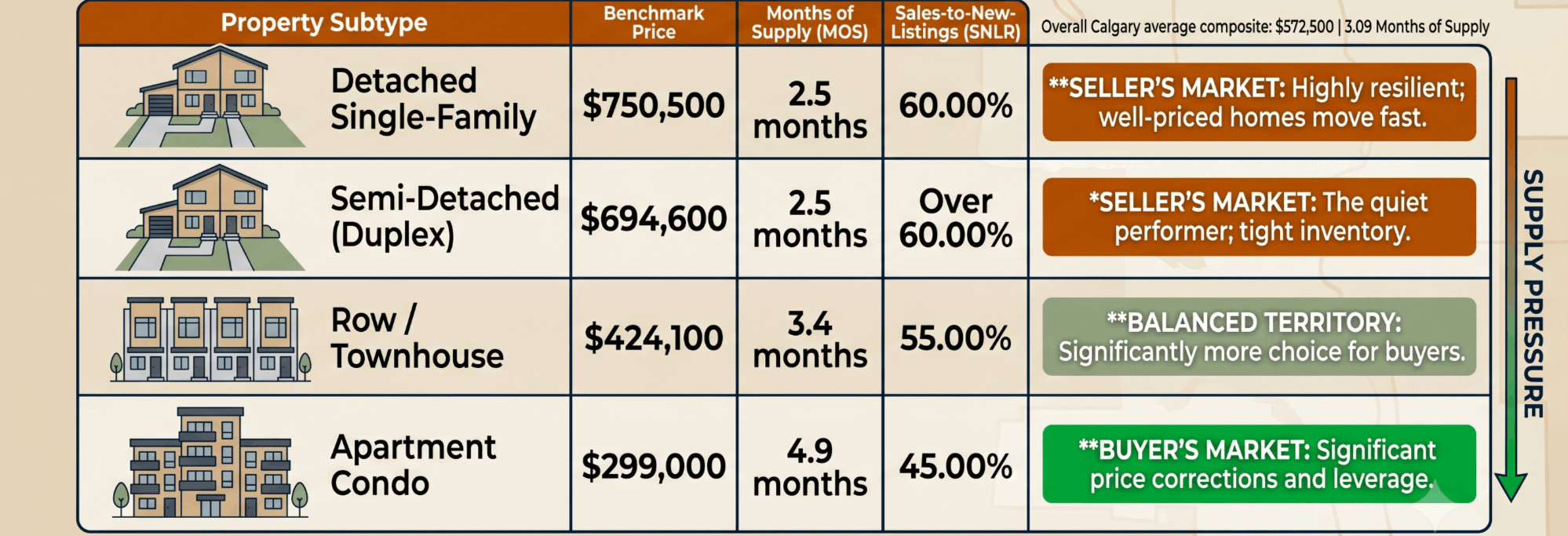
Ground-oriented properties (detached and semi-detached homes) remain locked in a tight seller's market due to low inventory, while the high-density multi-family sector (townhomes and condos) has flipped into a highly buyer-friendly market correction.
A massive pipeline of newly completed construction projects has flooded the condo and townhome sectors with fresh choices, completely shifting the dynamic for entry-level buyers.
The Detached Anchor
Single-family detached homes continue to anchor the city. Driven by local growing families and interprovincial buyers moving into Alberta, inventory remains constrained at just 2.5 months of supply. While prices are slightly lower (1.4%) than last summer's record highs, competitive detached homes under $600,000 are still selling quickly.
The Townhome and Condo Opportunity
If you are looking at row townhomes or apartment condos, the landscape has completely changed. Condo apartment sales dropped 20.5% year-over-year, pushing active inventory up to 2,076 units. With months of supply sitting at a heavy 4.9 months, condo prices have corrected downward by 9.0% compared to last year.
Location Matters: District-Level Price Changes
Where you look in the Calgary metropolitan area determines how much power you have at the negotiating table. High-demand corridors like West Calgary and the City Centre are still holding near record-high single-family pricing, whereas suburban entry-level quadrants are seeing significant supply additions and noticeable price drops.
-
West Calgary ($734,800 total benchmark): Still firmly a seller's market. Detached benchmarks here average $1,025,000 as inventory stays low.
-
South Calgary ($582,300 total benchmark): Operating in a stable, balanced-to-seller range. A great mix of tight detached options but highly favorable townhome opportunities.
-
North East & East Calgary ($465,600 & $399,600 benchmarks): These quadrants are experiencing clear oversupply. Detached home benchmarks have dropped 6.8% in the North East and 5.0% in the East, representing the most affordable entry-level pricing paths in the city limits.
Across the city, the average sale-to-list price ratio has dipped to 98.27%. Sellers are no longer automatically getting above-asking prices, and buyers have successfully re-introduced critical conditions like financing and home inspections back into their offers.
Why Is the Market Cooling Down?
Two core macroeconomic factors are driving this transition toward balanced real estate conditions:
-
Slowing Migration: Following the record-breaking population influx of 2024 and 2025, migration into Alberta has finally normalized. Calgary's projected population growth for this year is around 1.3% to 1.6% (roughly 34,000 new residents)—a steep drop from the 53,000 downpour last year, which has immediately cooled off rental and entry-level purchase urgency.
-
The Construction Wave: Builders have been working overtime. Calgary currently has over 22,200 units under construction. As these multifamily projects finish up, they supply the market with thousands of new options, erasing the housing deficit.
Meanwhile, borrowing costs remain a structural headwind. The Bank of Canada held its policy rate steady at 2.25% (keeping bank prime at 4.45%), meaning current fixed mortgage rates are hovering around 4.09%. Additionally, a massive wave of 2021 mortgage renewals is hitting the market, pushing a steady stream of properties into the resale inventory as owners adjust their household budgets.
Transparent Strategies for the Summer Market
This transition isn't a crash; it is an orderly, healthy correction toward a predictable market phase.
-
If you are buying: You hold real leverage in the condo and townhome sectors. Take your time, look at neighborhood-level sales statistics, and ensure you include essential property inspection terms.
-
If you are selling: The days of setting an unrealistic price tag and expecting five cash offers overnight are gone. Ground-oriented single-family homes are still in demand, but accuracy, modern digital marketing, and clear presentation are essential to stand out against rising inventory.
Categories
Recent Posts